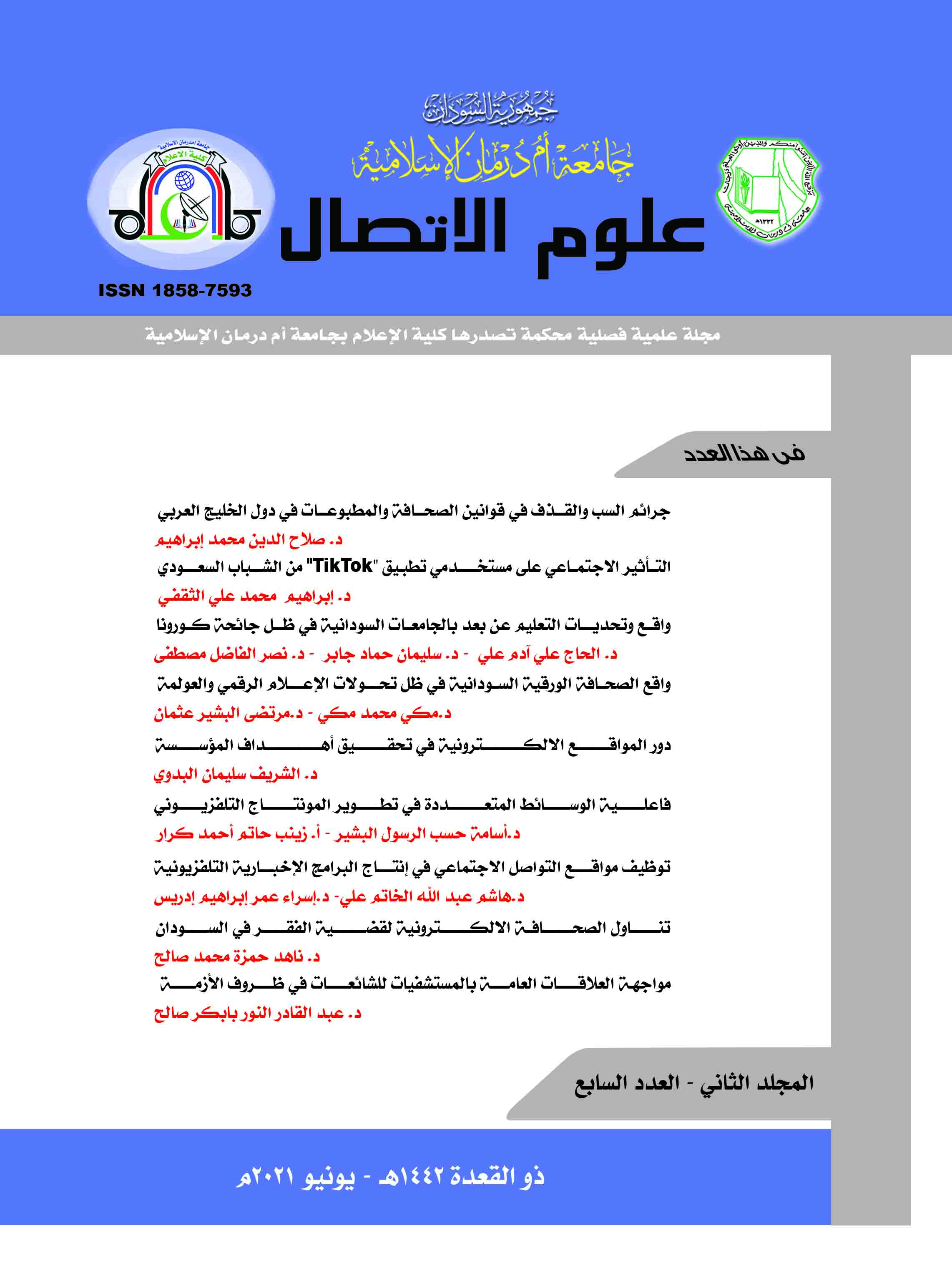
Social impact on users "TikTok" app from Saudi youth and its relationship
(with various types of Social Capital theory)
Abstract
This study aimed to identify the extent of social impact on users "TikTok" app from Saudi youth and its relationship with various types of Social Capital (transient, communicative, and associative), in addition to identifying the intermediate variables in the realization of social capital.
The study relied on “Social Capital Theory” in providing an explanation of the role which played by the application of “TikTok” in enhancing relations, trust and cooperation among Saudi youth. Therefore, the study used the method of surveying the audience through the survey questionnaire, and the study sample amounted to 345 individuals from Saudi youth.
The results of the study reached include the following:
- Saudi youth use the "TikTok" application at an average level, with differences in the intensity of use according to gender, in favour of females.
- The largest percentage of Saudi youth use pseudonyms and expressive images more than they use their personal photos in the account profile on the "TikTok" application.
- The Social Capital of communicative and transient for Saudi youth on the application "TikTok" is average, with the superiority of the transient Social Capital, which means that young people employ the application to a higher degree in communicating with people who are strangers or different from them.
- Saudi youth didn’t use the "TikTok" application much to communicate with relatives, colleagues, and people with whom they are closely related.
- There is a strong positive correlation between Saudi youth’s addiction to the application of "TikTok" and the rates of realization of Social Capital (the communicative relationship - the correlation - the transient relationship).
References
1. عبود، محمد.. (2021, Mar 27) اتجاهات ومؤشرات استخدام تيك توك في مصر والسعودية والإمارات 2020. Retrieved from https://expandcart.com/ar/56249-%D8%AA%D9%8A%D9%83-%D8%AA%D9%88%D9%83/
2. صفاء عثمان وعلياء عنتر (2020). تأثير استخدام مواقع التواصل الاجتماعي على رأس المال الاجتماعي والسعادة لدى المقيمين في دولة الإمارات، مجلة Arab Media & Society، العدد 29، ص67.
3. غمشي، الزهرة بن غربية فلة (2020). رأس المال الاجتماعي الافتراضي وتداول المراجع العلمية بين طلبة ما بعد التدرج على شبكة الفايسبوك. مجلة الباحث الاجتماعي، عدد 13 (2) ص473.
4. كمال، آمال. (2011). استخدام طلاب الجامعات المصرية لمواقع الشبكات الاجتماعية وعلاقته برأس المال الاجتماعي بالتطبيق على موقع الفيسبوك، المجلة المصرية لبحوث الرأي العام، المجلد العاشر، العدد الرابع، يوليو/ ديسمبر 2011، ص46
5- مؤيد، هيثم جودة (2016). إدمان مواقع التواصل الاجتماعي وعلاقته بمنظومة القيم الاجتماعية والأخلاقية لدى الشباب الجامعي المصري والسعودي، دراسة مقارنة في إطار نظرية رأس المال الاجتماعي. مجلة بحوث الصحافة، كلية الاعلام، جامعة القاهرة.
6- الشامي، علاء (2013). مواقع التواصل الإلكتروني ورأس المال الاجتماعي في المجتمع السعودي: دراسة استطلاعية على عينة من مستخدمي الفيس بوك في مدينة الرياض، المجلة العربية للإعلام والاتصال، ص50 – 51.
7- بلحنافي، أمينة، ومختاري، فيصل (2017). إشكالية رأس المال الاجتماعي بين المفهوم والقياس، Majallat al-Ḥikmah lil-Dirāsāt al-Iqtiṣādīyah، ص1-22.
8- القحطاني، سعد (2015). الإحصاء التطبيقي: المفاهيم الأساسية وأدوات التحليل الإحصائي الأكثر استخداما في الدراسات والبحوث الاجتماعية والإنسانية باستخدام SPSS، ط1 (الرياض: معهد الإدارة العامة)، ص290.
المراجع باللغة الإنجليزية:
9- Masciantonio, A., Bourguignon, D., Bouchat, P., Balty, M., & Rimé, B. (2021). Don’t put all social network sites in one basket: Facebook, Instagram, Twitter, TikTok, and their relations with well-being during the COVID-19 pandemic. PloS one, 16(3), e0248384.
10- Utz, S., & Muscanell, N. (2015). Social media and social capital: Introduction to the special issue.
11- Poecze, F., & Strauss, C. (2020). Social Capital on Social Media—Concepts, Measurement Techniques and Trends in Operationalization. Information, (11), 515.
12- Bourdieu, P. (1986). The forms of capital, In J. Richardson (Ed.) Handbook of Theory and Research for the Sociology of Education, (New York, Greenwood), 241-258.
13- Coleman, J. S. (1988). Social capital in the creation of human capital. American journal of sociology, 94, S95-S120.
14- Putnam, R. D. (1994). Social capital and public affairs. Bulletin of the American Academy of Arts and Sciences, 5-19.
15- Stacey Alicea. Social Networks in Community Colleges: Influences on Social Capital, Academic Achievement, Employment Skills and Psychosocial Wellbeing, unpublished doctoral dissertation, New York University ,2015, P.22
16- Page-Tan, C. (2021). Bonding, bridging, and linking social capital and social media use: How hyperlocal social media platforms serve as a conduit to access and activate bridging and linking ties in a time of crisis. Natural Hazards, 105(2), 2219-2240.
17- Matenda, S., Naidoo, G. M., & Rugbeer, H. (2020). A study of young people's use of social media for social capital in Mthatha, Eastern Cape. Communitas, 25, 1-15.
18- Yang, Y., & Zilberg, I. E. (2020). Understanding Young Adults' TikTok Usage.
19- Rashid, A. I., & Almallah, I. T. H. (2020). Social capital and the extent of its contribution to enhancing the management of excellence: An applied study at Azadi Hospital/Duhok. journal of Economics and Administrative Sciences, 26(124).
20- Hair, J.F., Black W.C., Babin, B. J., & Anderson, R.E. (2014). Multivariate Data Analysis (Seventh Edition).USA: Pearson Education Limited., P. 7.
21- Sekaran, U., & Bougie, R. (2016). Research methods for business: A skill building approach (Seventh edition). UK: John Wiley & Sons.P.222.
22- Pituch, K. A., & Stevens, J. P. (2016). Applied multivariate statistics for the social sciences (6th edition). New York: Routledge.